
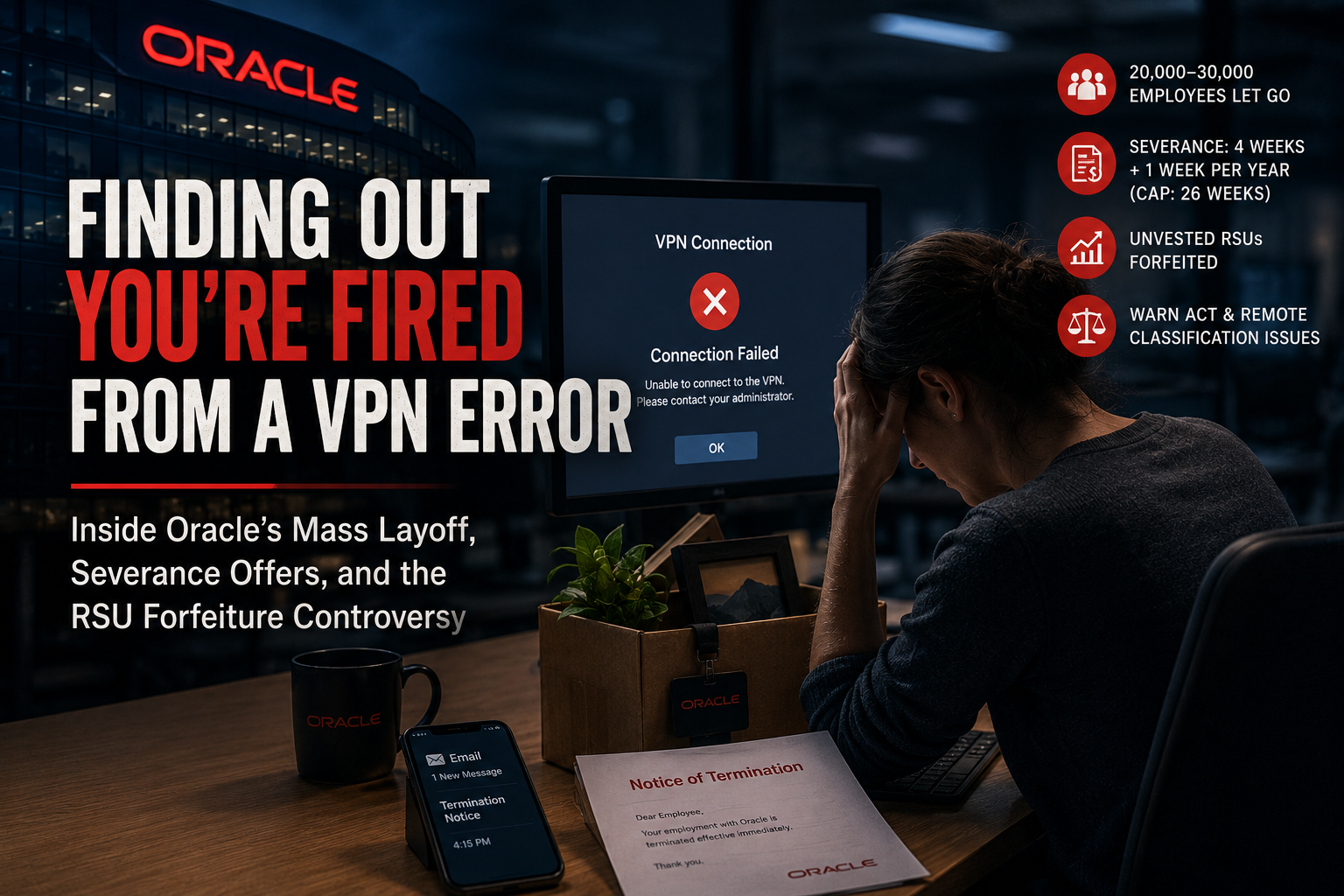
Finding Out You’re Fired From a VPN Error
One of the Oracle employees let go on March 31 didn’t get a call. Didn’t get a meeting. She tried to log into the VPN and got an error. Called a friend to ask if she could still be seen on Slack. She couldn’t. A few minutes later, an email confirmed it: her role was terminated, effective immediately.
Oracle cut an estimated 20,000 to 30,000 employees that day, according to widespread reports. The severance offer arrived a few days after the termination notice — and that’s when things got complicated.
What Oracle Actually Offered
On paper, the severance terms looked like standard corporate boilerplate. In exchange for signing a release waiving their right to sue, employees received four weeks of base pay for the first year, plus one additional week per year of service, capped at 26 weeks. Oracle also covered one month of COBRA health insurance.
That sounds passable — until you look at the stock situation.
The RSU Problem
At Oracle, stock compensation often makes up the majority of a tech worker’s total pay. But the company did not accelerate RSUs that hadn’t vested yet. Any unvested shares were simply forfeited — even if those shares were granted as retention incentives or in place of salary increases tied to promotions.
One long-tenured employee lost $1 million in stock that was just four months away from vesting. RSUs made up roughly 70% of his total compensation, according to reporting by Time. That’s not a rounding error. That’s the bulk of what someone builds toward over years of work, gone overnight.
The Remote Worker Classification Trap
Some employees also ran into a classification problem. If Oracle had them on record as remote workers — even if they lived near an office and came in on a hybrid schedule — the company argued they didn’t qualify for WARN Act protections.
The WARN Act requires companies to give employees 60 days’ notice before a mass layoff, or pay in lieu of that notice. It kicks in when 50 or more people at a single location are affected. By classifying workers as remote, Oracle could sidestep the location threshold entirely.
Here’s the thing — even for employees who were covered by the WARN Act, it didn’t necessarily mean more money. Oracle folded the two-month WARN notice pay into its existing severance calculation rather than stacking it on top. States like California and New York have stronger worker protections, but remote workers in other states were largely on their own.
How Oracle’s Package Compared to Other Tech Layoffs
A group of affected employees put together a petition signed by at least 90 people, asking Oracle to match what other major tech companies were offering during their own AI-driven restructurings. The comparison didn’t flatter Oracle.
| Company | Base Severance | COBRA Coverage | RSU Acceleration |
|---|---|---|---|
| Oracle | 4 weeks + 1 week/year (cap: 26 weeks) | 1 month | None |
| Meta | 16 weeks + 2 weeks/year | 18 months | Not specified |
| Microsoft | Minimum 8 weeks + 1–2 weeks per 6 months of service | Not specified | Yes — accelerated |
| Cloudflare | Base pay through end of 2026 | Through end of year | Yes — accelerated through Aug 15 |
Meta’s package, as reported by Business Insider, started at 16 weeks of base pay plus two additional weeks for every year of service, with COBRA covered for 18 months. Microsoft — which extended voluntary retirement offers to long-serving employees — provided accelerated vesting, a minimum of eight weeks’ pay, and extra weeks based on tenure and rank. Cloudflare, which cut 20% of its workforce, offered a lump sum equivalent to base pay through end of 2026, healthcare through year-end, and accelerated stock vesting through August 15.
Oracle’s offer wasn’t close to any of them.
Oracle Refused to Negotiate — And Nobody Was Surprised
The 90-person petition went nowhere. According to an email reviewed by TechCrunch, Oracle declined to negotiate. It was a take-it-or-leave-it situation — sign the release, accept the terms, move on.
Oracle declined to comment when asked about its severance terms, the remote worker classification issue, or the failed negotiation attempt.
The honest answer is that almost no one expected a different outcome. But the refusal to even engage with employees is a useful reminder of something tech workers often forget during good markets: high pay and stock grants are valuable when companies are growing and when you stay employed. The moment a company decides it’s done with you, most of those protections disappear. There’s no union. There’s no floor. There’s just whatever the company decides to offer — and whether you want to fight it in court.
Frequently Asked Questions
What severance did Oracle offer laid-off employees in 2026?
Oracle offered four weeks of base pay for the first year of employment, plus one additional week for each subsequent year, capped at 26 weeks total. Employees also received one month of COBRA health insurance coverage. Unvested RSUs were forfeited and not accelerated.
Did Oracle accelerate RSU vesting for laid-off workers?
No. Oracle did not accelerate unvested RSUs for employees who were laid off. Any shares that hadn’t vested by the termination date were forfeited — regardless of whether the stock was granted as a retention incentive or tied to a promotion.
What is the WARN Act and did it apply to Oracle layoffs?
The WARN Act requires companies to provide 60 days’ advance notice before mass layoffs affecting 50 or more employees at a single location. Oracle reportedly classified some employees as remote workers, which allowed the company to argue those workers didn’t meet the location requirements for WARN Act coverage.
How did Oracle’s severance compare to Meta and Microsoft?
Oracle’s package was significantly less generous. Meta offered 16 weeks of base pay plus two weeks per year of service, with 18 months of COBRA. Microsoft provided accelerated RSU vesting and a minimum of eight weeks’ pay. Cloudflare paid base salary through end of 2026 and accelerated stock vesting.
Did Oracle employees successfully negotiate better severance?
No. At least 90 employees signed a petition asking Oracle to improve its terms. Oracle declined to negotiate, according to internal communications reviewed by TechCrunch.
The Bottom Line
Oracle’s mass layoff in 2026 exposed something uncomfortable about how compensation works in tech. RSUs and stock grants look great on paper — and they can be genuinely life-changing when they vest. But unvested stock is only worth something if you stay employed long enough to receive it. When a company decides to cut tens of thousands of people at once, those future earnings can vanish in a single email.
The employees who pushed back on Oracle’s severance terms weren’t wrong to try. They just found out what most workers eventually learn: leverage disappears fast when the company has already made its decision. Understanding what you’re actually owed — WARN Act rights, state-specific protections, how RSU forfeitures work — matters most before a layoff happens, not after.